


Open for Business. Open for Discovery.
Sierra Leone emerges as a captivating destination for both intrepid explorers and forward-thinking investors. Nestled on the Atlantic coast, our country provides a one-of-a-kind investment landscape fuelled by abundant biodiversity, a 500-kilometer pristine coastline, and a rich cultural heritage. As we actively diversify our economy, the Sierra Leone government has prioritised tourism as a long-term economic growth driver. We provide a very favourable investment climate, a skilled workforce, and the opportunity to create something truly extraordinary. You have the opportunity to experience freedom.
Opportunities Await
Discover lucrative opportunities across our diverse and growing tourism landscape.
The Land
Sierra Leone is located on the west coast of Africa, bordered by Guinea to the northeast,
Liberia to the southeast, and the Atlantic Ocean to the southwest. It’s between
7 and 10 degrees north of the Equator, and its total area measures 71,740 km2 (27,699 sq mi).
The territory also includes a number of islands, of which Bunce Island, Banana and Turtle
islands are the best known.
There are four distinct geographical regions in Sierra Leone, creating a diversity of ecology
and landscapes that tourists really enjoy. The coast is largely flat and covered in mangrove
swamps; followed by rainforest-covered hill country in the center, an upland plateau and
mountains in the eastern part of the country.
Agriculture is mainly practiced in the central highlands. The main crops are rice, cassava,
groundnuts, sweet potatoes and maize, while the most common livestock are cattle and sheep.
Sierra Leone has 400 km of coastline, including the Freetown Harbour, one of the largest in
the world, adjacent to capital city Freetown. The country is home to 8.9 million people, 1 million
of whom live in Freetown.
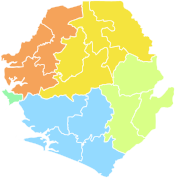
Provinces
The Northern Province
The Northwest Province
The Northwest Province extends to the border with Guinea. The largest city is Port Loko, and the main activities are farming, fishing and mining.
The Southern Province
The Southern Province has stunning beaches, historical landmarks, and great opportunities for wildlife-watching in Tiwai Island. The lively city of Bo, the second largest city in the country, is its capital.
The Western Province
The Western Area includes the capital Freetown, and it is the economic and political center of Sierra Leone.
The Eastern Province
The Eastern Province is home to the Gola Rainforest and Loma Mountains, and it’s the center of the diamond mining industry in the country. The provincial capital is Kenema, worth visiting for its colorful markets.
The Northern Province
The Northwest Province
The Northwest Province extends to the border with Guinea. The largest city is Port Loko, and the main activities are farming, fishing and mining.
The Southern Province
The Southern Province has stunning beaches, historical landmarks, and great opportunities for wildlife-watching in Tiwai Island. The lively city of Bo, the second largest city in the country, is its capital.
The Western Province
The Western Area includes the capital Freetown, and it is the economic and political center of Sierra Leone.
The Eastern Province
The Eastern Province is home to the Gola Rainforest and Loma Mountains, and it’s the center of the diamond mining industry in the country. The provincial capital is Kenema, worth visiting for its colorful markets.
Climate
Sierra Leone has a tropical climate characterized by hot and humid conditions year-round. There are two distinct seasons – the dry and the wet season. The dry season typically lasts from November to April, and is the best time to visit the country with sunny days, warm temperatures, and low humidity. The most pleasant months in Sierra Leone are December and January; after that, harmattan season begins, characterized by a hot and dry wind from the Sahara that brings extreme heat and hazy skies.
The rainy season lasts from May to October, bringing heavy rainfall and high humidity to the country. During this time, the country’s rivers swell, and the vegetation becomes truly lush. While the rain can be intense, it usually falls in short, heavy bursts, followed by sunny intervals – however, intense floods may also occur, washing our roads and making traveling around the country more complicated.
Rivers & Mountains
Rainforests
People
Languages
Religion
Food & Festivals
Rainforests
People
Languages
Religion
Sierra Leone is a secular country, with no official religion. However, most inhabitants follow a faith, with Islam and Christianity as the two most commonly practiced.
Approximately 78% of the population is Muslim (mostly Sunni), while around 20% is Christian, (mainly Protestant), with the remaining percentage practising traditional African beliefs or other faiths. Islam is most prevalent in the northern and eastern regions of the country, while Christianity is more common in the western and southern regions.
Despite religious differences, Sierra Leoneans generally coexist peacefully, and religious tolerance is a core value in Sierra Leonean society. Interfaith marriages are common, and religious celebrations and festivals are often observed by people of different faiths. Both Christian and Muslim festivities are official holidays in the country.
Traditional beliefs and customs also play a significant role in Sierra Leonean culture, particularly in rural areas, where rituals and ceremonies are an integral part of community life.
Food & Festivals
Modern Era
Slavery
In the 15th century, Portuguese explorers arrived on the coast of Sierra Leone, followed by European traders and colonizers who established forts and trading posts along the coast. The country’s name derives from Sierra Lyoa, meaning Lion Mountain in Portuguese, the first name for what is now the Freetown Peninsula.
Local chiefs at first welcomed European sailors for the commercial opportunities they provided. Portuguese influence lasted until the 17th century, when it started to be replaced by other colonial powers – mainly the Dutch and English. Around the same time, the transatlantic slave trade started to last approximately three centuries.
In the latter part of the 18th century, plans were made for formerly enslaved Africans to return to the Continent and settle in modern-day Sierra Leone. Some of these first settlers are the founders of Freetown, taking its name from the fact it was meant to be a free haven for these recently liberated people.
British colonial rule continued up until 1961, following a series of riots and resistance movements, the best known of which was the Hut Tax war in 1898, started by Temne chief Bai Bureh who is still recognized as a national hero.
The first post-colonial years were stable and prosperous, but this all came to an end with a series of military coups in the 1960s, followed by a bloody civil war that ravaged our country between 1991 and 2002. Sierra Leone is now a peaceful and stable country, growing its economy year after year and slowly erasing the scars of these recent tragedies.
Ready to Build the Future of Tourism in Sierra Leone?
Sierra Leone is one of West Africa’s most vibrant and untouched destinations, offering unparalleled potential for sustainable tourism, infrastructure, and hospitality investments. Whether you are looking to develop world-class eco-lodges along our pristine coastline, introduce unique cultural excursions, or partner with local operators, our doors are open. The Ministry of Tourism and Cultural Affairs is ready to support your vision with flexible incentives and a collaborative business environment.